Material Intelligence / Specifier Guide
What Evidence Should You Request for an Outdoor Furniture Material?
A practical matrix for reviewing outdoor furniture materials across identity, exposure, colour, weathering, form, joinery, maintenance, samples and test scope.

An outdoor furniture material is rarely approved on appearance alone. A designer may begin with colour, grain and touch, but the decision soon expands: What will the component look like at an edge? How will it meet the frame? What exposure will it face? Which cleaning routine will the operator use? What evidence supports the claims being made?
The difficult part is not collecting the largest possible technical file. It is matching each design decision to evidence that actually addresses it.
A standard number without a specimen, result or scope is not a performance answer. A laboratory exposure is not automatically a forecast of service life. A material test does not by itself establish the safety or durability of a finished chair. And an environmental logo cannot substitute for the exact product, boundary and claim under review.
The following matrix gives design and specification teams a more disciplined way to move from an attractive material image to a decision-ready record.
01 / Frame the decision
Begin with the decision, not the document.
Before asking a supplier for reports, describe the decision the project team is trying to make.
- Is the team choosing a finish or approving a finished component?
- Is the material being considered for a shaded terrace, an uncovered restaurant, a poolside setting or a coastal resort?
- Is the component flat, machined, joined, fastened or formed into a curve?
- Is the use residential, hospitality, contract or another defined duty level?
- Is the evidence needed for visual approval, engineering review, procurement, an environmental statement or finished-product testing?
This framing prevents a common failure: receiving a technically impressive report that evaluates a different specimen, property or use condition from the one that matters to the project.

02 / Review matrix
The outdoor-material evidence matrix.
Use one row for each decision area. The final column is as important as the evidence request because it records what the document does not prove.
| Decision area | Ask for | Record | Do not infer |
|---|---|---|---|
| Material identity | A current manufacturer-approved formulation or category statement | Version, date, issuer and product or sample identity | Composition, recycled content or fibre status from an old web description |
| Intended application | Product form, component geometry, duty level and stated limits | Profile, section, joint, hardware and use context | Universal suitability from an ‘outdoor’ label |
| Exposure | Sun, wetting, salt or pool contact, temperature cycles, cleaning and storage assumptions | Site conditions and worst credible exposure | Coastal or poolside suitability without matched evidence |
| Colour and appearance | Viewing method, control sample and visual or measured comparison | Finish, specimen, light, method and acceptance rule | ‘Never fades’ from one image or an unscoped test-hour total |
| Weathering and conditioning | Method and edition, cycle, specimen, property measured and result | Laboratory, report date, units and interpretation limit | Outdoor service years without a validated correlation |
| Form and joinery | Profile limits, forming process, radius, machining and fastening guidance | Highest-risk curve, joint, tolerance and prototype outcome | That general formability proves a particular component |
| Finished furniture | Applicable safety or mechanical requirement and product scope | Product category, duty level, configuration and result | Finished-product compliance from a material test |
| Care and maintenance | Approved cleaning method, prohibited chemicals, inspection and repair guidance | Operator routine, access and replacement assumptions | ‘Zero maintenance’ because timber oiling is not required |
| Environmental statement | Exact claim, method, product boundary, geography and responsible issuer | Wording, denominator, system boundary and current route | Recycled content, recyclability, closed loop or certification from a logo alone |
| Physical review | Full finish set, edge, section, joint, formed detail and adjacent materials | Review light, observers, observations and selection | Tactile, colour or construction suitability from screen imagery |
The matrix is deliberately broader than a laboratory checklist. Outdoor furniture is a material, component and operating system at the same time. The decision record must connect all three.
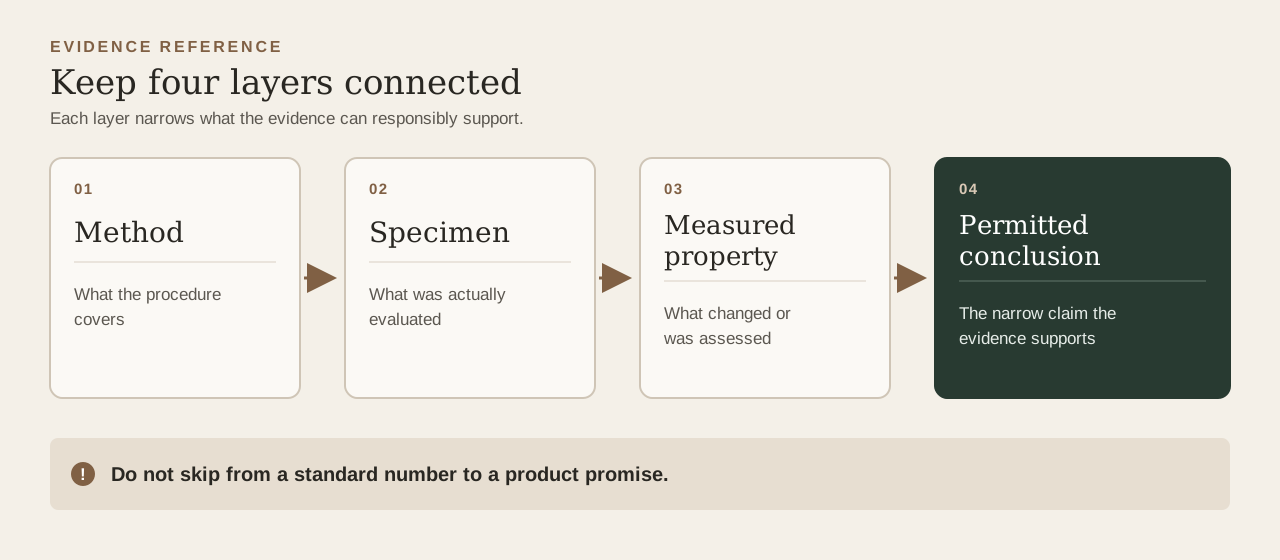
03 / Read the reference
Read every technical reference in four layers.
1. What does the method cover?
A method defines how something is evaluated. It may cover apparatus, conditioning, viewing conditions, loading or reporting. It does not necessarily establish a product requirement.
For example, ISO 4892-1:2024 provides general guidance and requirements for laboratory light-source exposure of plastics and includes information on interpreting artificial accelerated-weathering or irradiation data. It is a framework for exposure and interpretation—not a declaration that any named product has achieved a particular result.
2. What specimen was tested?
Record the material grade, colour, dimensions, preparation, conditioning and production date where available. Ask whether the specimen represents the finish, section and process under consideration.
A flat plaque and a formed furniture component may raise different questions. The report may still be useful, but its limits should be visible in the decision record.

3. What property was measured?
An exposure report may measure colour change, gloss, surface condition, mechanical retention or another property. Test duration alone is not the result.
The team should record the unit, initial value, final value, comparison method and any acceptance criterion. If colour is judged visually, viewing conditions and observer practice matter. ASTM D1729-22, for example, is an active practice for visual appraisal of colour and colour differences in diffusely illuminated opaque materials. Its scope does not turn a subjective product photograph into a controlled colour assessment.
4. What conclusion is permitted?
Write the narrowest conclusion supported by the document. “Evaluated using a stated laboratory exposure” is different from “suitable for every outdoor environment.” A measured change after a defined cycle is different from a promise of years in service.
If the conclusion requires assumptions outside the report, list them as open questions rather than hiding them inside marketing language.
04 / Separate the scales
Keep the material, component and finished product separate.
A material can have relevant test data and still require a component mock-up or a finished-furniture evaluation.
This distinction becomes especially important when a standard addresses assembled furniture. BS EN 581-1:2017 covers general safety requirements for outdoor seating and tables within its stated use categories. BS EN 581-2:2026 addresses general and structural safety for outdoor seating, including strength, reliability and stability. Its public scope also states that it does not cover resistance to ageing and degradation caused by light, temperature and moisture.
That boundary is useful. It shows why one standard number cannot carry the entire material story. A project may need separate records for:
- material identity and surface behaviour;
- accelerated exposure or conditioning;
- the formed or machined component;
- the joint, frame and hardware;
- the assembled seating or table;
- cleaning, inspection, repair and replacement.
The responsible team should confirm which regional, procurement and project-specific requirements apply. The matrix supports that review; it does not replace it.

05 / Localise the questions
Change the questions by market—not the underlying facts.
One evidence core can serve different markets, but regional teams may need to emphasise different questions. Localisation should begin with project conditions and decision responsibilities, not with translated marketing claims.

United States: contract and development review
For a US outdoor-furniture brand or hospitality project, begin with the intended duty level and the route from material to repeatable component.
Ask:
- Which evidence applies to the raw material, which to the component and which to the assembled product?
- What profile, joint, fastener, drainage and replacement assumptions are built into the design?
- Which property was measured in any accelerated-weathering report?
- Can the supplier support profile review, prototyping and production control rather than only supply a standard board?
- Which project, procurement or jurisdiction-specific requirements must the responsible design team confirm?
Avoid treating “contract,” “coastal” or another category label as proof. The evidence must follow the actual configuration and decision.
Europe: documentation depth and claim boundaries
For European work, the evidence request may place more emphasis on traceable raw-material information, chemicals, maintenance, repairability, replacement and the precise basis of environmental statements.
The Nordic Swan criteria for outdoor furniture, playground and park equipment offer one example of the breadth a formal documentation framework can cover, including constituent materials and chemicals, warranty, spare parts and circular design. They are cited here only to illustrate documentation depth. Their existence does not imply that a material or product is certified, compliant or under assessment.
Ask:
- Is the material statement current, dated and issued by the responsible manufacturer?
- Is an environmental claim defined by method, product boundary, geography and date?
- Does a cited reference apply to a material, seating, tables or a finished configuration?
- Is the supplier describing testing to a method, conformity to a requirement or third-party certification?
- Which country, language, procurement route or project requirement needs separate confirmation?
Those distinctions make documentation more useful and reduce the risk of turning a narrow result into a broad public claim.
Australia: exposure and operating reality
For an Australian coastal, poolside or hospitality project, replace the national label with a site-specific exposure map.

Ask:
- What combination of sunlight, wetting, airborne salt, pool chemicals and cleaning is credible for the site?
- How do drainage, hardware, joints and adjacent metals change the component review?
- What colour or surface change is acceptable to the design team and operator?
- Which cleaning agents and inspection routines will actually be used?
- Is the highest-risk edge, curve or fixing represented in a physical mock-up?
- Does the evidence relate to the selected specimen and application, or only to a broad material family?
The objective is not to obtain a blanket “Australia-ready” or “marine-grade” assurance. It is to make the exposure, evidence and remaining design responsibility explicit.
06 / Make the review physical
Use the physical sample to test the material language.
Documents can narrow risk, but they cannot replace the physical review of a design-led material.
Review the full finish set rather than one preferred colour. Look at the principal surface, edge and section. Place the material beside the intended metal, textile or stone. Compare it under the studio’s controlled light and the project’s relevant daylight. Include a joint, machined detail or controlled curve if that feature carries the design intent.
Record who reviewed the samples, under what light and against which acceptance criteria. A physical review is not a laboratory result, but it is still evidence when the method and decision are documented.
For a formed or joined component, prototype the highest-risk transition first: the tightest radius, most visible joint, thinnest section or most exposed fixing. This is usually more informative than producing a polished prototype that avoids the difficult detail.
One-page decision record
Build a one-page decision record.
The output of the process should be concise enough to use. A one-page decision record can include:
- Project, application and duty level
- Exposure and cleaning map
- Selected material, finish, profile and component
- Evidence reviewed, with document dates and specimen identity
- Physical sample and mock-up observations
- Conclusions supported by the evidence
- Open questions and responsible owner
- Final approval, conditions and review date
This gives the designer, technical team, supplier and operator the same reference point. It also makes later changes visible: if the finish, profile, factory process, joint or use condition changes, the team can see which parts of the evidence review need to be reopened.

From evidence request to material conversation
The strongest specification process does not force a choice between material character and technical discipline.
It asks both to become more precise.
Sumparwood is a proprietary, wood-like outdoor material developed with furniture-making intelligence for designers, architects and premium outdoor-furniture brands. Its material conversation begins with surface, edge, solid section and four physical finishes, then moves into the selected profile, joint or controlled curved form.
Design and project teams can begin with the complete Sample Box and request the relevant evidence index within each document’s stated scope.