26 October 2026
Outdoor furniture cleaning: agree the trial before cleaning the whole set.
One identified surface. One permitted method. A decision you can explain to the next team.
Use the Trial Cleaning Record ↓
A terrace needs cleaning before guests arrive. Someone suggests a product already used elsewhere on site. The furniture looks straightforward, and the team wants to finish the whole set in one visit. This is the moment to slow the decision, not necessarily the work.
A cleaning trial is useful only when the next person can understand what was tried, where it was used and what happened afterwards. A clean-looking patch, without that record, leaves too much open. It does not identify the surface, authorize the method or explain whether the appearance changed after drying.
For hospitality and facilities teams, the practical aim is a repeatable decision: an identified furniture part, a method permitted for that part, a recorded trial and a review before the work expands. The framework below is an editorial planning aid. It is not a cleaning recipe or a substitute for the furniture maker’s current instructions.
01 / Trial planning
Start with the part, not the product bottle
One chair may bring together a frame, an exposed finish, upholstery, seams and fittings. A method allowed on one part is not automatically allowed on its neighbours. Start by identifying the furniture model and the particular surface being considered. Keep the supplier’s care reference beside that identification.
Gloster’s Product Care library separates guidance by materials, including fabrics, aluminium, teak and rope. That structure is a useful reminder to find the relevant instructions rather than treating an outdoor chair as one undifferentiated surface. It does not tell us which method is suitable for a different brand’s furniture.
If the item’s identity or finish is uncertain, record that uncertainty and ask the maker. A product photograph, a familiar colour or a timber-like appearance cannot resolve the care specification. Where several models share a terrace, give each proposed cleaning scope its own clear identity.
02 / Trial planning
Obtain a permitted method before choosing a trial area
“Try a hidden spot” should not become permission to try any chemical. First check whether the proposed product, tool and method are allowed by the furniture supplier. Read any exclusions. If the instructions prohibit the approach, a small trial does not cancel that restriction.
Where the guidance is unclear, send the supplier a concise question. Identify the item, the part, the mark or soil being addressed and the proposed product. Ask for the relevant method and an acceptable trial location. Do not invent a patch size or contact time while waiting for an answer.
An inconspicuous area can still be visible later, or have a different exposure and construction from the main surface. Ask whether the chosen location is representative enough for the intended decision. An approved loose reference sample may help discussion, but it does not automatically represent an assembled chair with different edges, joints and adjacent materials.
03 / Trial planning
Separate handling information from compatibility
Keep the cleaning product’s identity precise. Record the name and the current label or instruction reference. If the supplier’s method depends on a particular version, retain that detail too. “The usual cleaner” is not a reliable description when shifts, contractors or products change.
Australia’s Comcare advises users to read labels and usage instructions, keep products in their original labelled containers and obtain manufacturer safety data sheets for workplace chemicals. Its kitchen cleaning guidance also explains that workplace exposure can differ from domestic use. That source concerns safe workplace handling, not outdoor furniture compatibility.
A safety data sheet and a furniture care instruction answer different questions. Neither should be used to fill gaps in the other. Follow the site’s applicable handling controls and obtain the furniture maker’s suitability guidance separately. This article does not select chemicals, protective equipment or legal compliance measures for a particular workplace.
04 / Trial planning
Make the starting condition readable
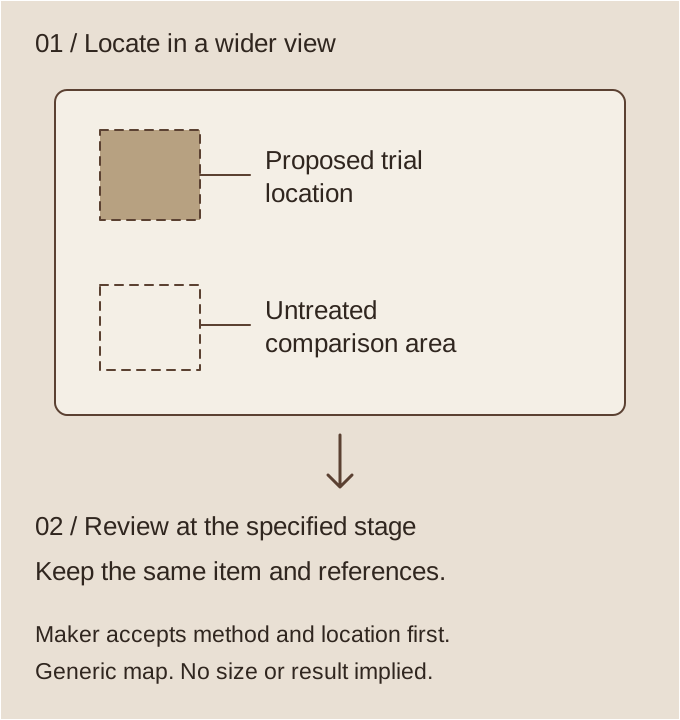
Before the authorized trial begins, photograph the identified part and its existing condition. Include a wider view that locates the trial, then a useful detail. Name the images so they remain connected to the item and date. Keep existing marks distinguishable from anything noticed later.
Record why this spot was selected and what nearby area will provide a visual reference. Use a location description or a marked photograph rather than applying an unapproved marker or adhesive to the furniture. The record needs to locate the area without introducing another treatment.
Try to make later photographs comparable in view and light. This is a practical observation aid, not a controlled laboratory comparison. Reflections, dampness and changing daylight can affect what a photograph appears to show. Include written observations so the decision does not depend on a single image.
05 / Trial planning
Record the complete method, including removal and drying
A product name alone cannot make a trial repeatable. Retain the authorized instructions and note the actual application method, tool and sequence used. Where the instructions specify preparation, concentration, contact, removal, rinsing or drying conditions, preserve those requirements without replacing them with a site-made shortcut.
Fermob’s maintenance guidance warns, within its metal-furniture care advice, about areas where cleaning products can remain trapped. That is a specific manufacturer example of why a method includes more than the visible surface being wiped. It is not a prescription for cleaning Sumparwood parts or another maker’s products.
For the trial at hand, check the permitted treatment of nearby components and any places reached by liquid or residue. If a detail is missing, ask before proceeding. Do not infer permission for a pressure device, abrasive tool or stronger mixture from the general phrase “outdoor use.” Record any departure from the agreed method and stop the review from quietly treating it as the original trial.
06 / Trial planning
Review after the specified drying stage
Do not judge only the freshly cleaned, still-damp surface. Follow the applicable instructions for drying and review. The point is not to invent a universal waiting period; it is to assess the result at the stage required by the authorized method.
For example, the directions for Sunbrella Clean Multi-Purpose Fabric Cleaner require a hidden-area colourfastness test on non-Sunbrella fabrics and examination when dry. They say not to use the product if colour or texture is affected. Those directions belong to that cleaner and stated fabric scope. They are not a recommendation for this site’s furniture, nor evidence that a frame or finish is compatible.
In the trial record, describe what was observed: colour, texture, sheen, a visible boundary, remaining soil or apparent residue, as relevant to the identified part. Keep observations separate from explanations that have not been confirmed. A patch that looks unchanged does not prove long-term durability, hidden-material compatibility or a warranty outcome.
07 / Trial planning
Use one Trial Cleaning Record
The following record connects the proposed work to the decision. It is an original editorial aid, not a test standard. Complete it with the furniture supplier’s applicable instructions and your site’s procedures. Blank information is a question to resolve, not an invitation to guess.
On small screens, scroll the record sideways to read all three columns.
| Record | What to retain | Decision it supports |
|---|---|---|
| Item and part | Model or asset reference, surface identity, care document and version | Are we discussing the same component? |
| Permission and limits | Maker’s permitted method, exclusions and accepted trial location | Is this trial within the stated scope? |
| Product and handling | Exact product reference, label and applicable workplace handling information | Can the team identify what was used? |
| Before condition | Located photographs, existing marks and comparison area | What was already present? |
| Actual method | Operator, date, tools and the prescribed application, removal and drying sequence | Was the agreed method followed? |
| Review | Dry-stage observations, comparable photographs and unresolved changes | Is there enough information to decide? |
| Next scope and owner | Named reviewer, hold or next step, identified items and method limits | Who decides what happens next? |
Keep the record short enough to use on site. Supporting instructions and photographs can sit behind it rather than being copied into every field. What matters is that a supervisor or incoming contractor can find the same references and see the limits of the decision.
08 / Trial planning
Expand the scope deliberately, not by resemblance
If the result raises a concern, hold the wider work and return the observations to the relevant supplier or reviewer. Do not respond by escalating the cleaner or repeating the treatment until the difference becomes harder to see. Keep the starting record intact.
If the reviewer accepts a next step, name the furniture items, parts and method covered. A trial on one finish is not automatic permission for another colour, upholstery option or weathered item. Even an accepted visible result should not be described as proof of every future cleaning cycle.
Make the agreed method accessible at the point of use. Our service information handover checklist explains how to connect furniture references with the people who need them. A useful cleaning record should travel with that information when contractors or responsibilities change.
09 / Trial planning
Bring the question to the right supplier
The strongest outcome is not a universal bottle recommendation. It is a clear route from an identified furniture part to an agreed method, an observable trial and a bounded next decision. That is easier to repeat than an undocumented success on one afternoon.
For a Sumparwood material enquiry, share the intended component and the care question by emailing our team. For an existing finished furniture item, start with its maker and current care instructions. A Sumparwood Sample Box supports material and finish discussion; it does not establish cleaning compatibility for an assembled piece of furniture.